


If your teeth are slightly uneven, chipped, or gapped, you may wonder whether you need months or years of orthodontic treatment to improve your smile. In some cases, the answer is no. Dental veneers Tumwater patients consider can improve the appearance of mildly uneven teeth without braces or clear aligners. Veneers are thin, tooth-coloured coverings placed over the surfaces of teeth to change their shape, size, colour, or appearance.
For patients with minor cosmetic concerns, veneers may help create a balanced-looking smile by disguising gaps, chips, or differences in tooth shape. However, they do not physically move teeth or correct bite and alignment problems.
If your teeth are significantly crowded, rotated, or misaligned, braces or clear aligners may be more appropriate. A dental professional can assess your teeth, bite, and oral health to determine which option suits your needs and help you make an informed decision about improving your smile.
At a Glance
- Veneers can visually correct minor unevenness, chips, gaps, and irregular shapes without moving the teeth.
- They don’t fix bite problems or significant misalignment, that’s the job of orthodontics.
- Treatment typically takes just a few visits, compared to months or years for braces.
- Porcelain veneers are custom-made to match the size, shape, and shade of your smile.
- A consultation with your dentist is the best way to find out if veneers are right for your case.
What Are Dental Veneers?
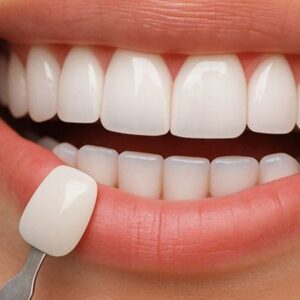
Dental veneers are thin, custom-made shells that cover the front surface of a tooth to change its shape, color, and alignment appearance. Unlike a crown, which wraps around the entire tooth, a veneer covers only the front side of the tooth, which means less of your natural tooth structure needs to be altered.
Veneers are typically made from porcelain or composite resin. Porcelain veneers are known for being strong, long-lasting, and natural-looking, which is why they’re a popular choice for patients who want a refreshed smile that still looks like their own teeth. For patients considering veneers in Tumwater , both options are available, and composite veneers are usually a faster, more affordable choice, though they may need touch-ups sooner than porcelain.
At Affordable Family Dental, veneers are custom-designed to blend with your surrounding teeth, so the goal isn’t a dramatically different smile, it’s a more even, balanced version of the one you already have.
How Do Veneers Correct the Look of Uneven Teeth?
Veneers correct the appearance of uneven teeth by covering the visible part of each tooth with a shell shaped to look straight, symmetrical, and uniform in size. A dentist in Tumwater WA can assess whether veneers are suitable for your teeth and cosmetic goals. Even though the tooth underneath hasn’t physically moved, veneers can change its visible appearance. This is different from orthodontics, which repositions the teeth themselves over time.
Because each veneer is custom-fabricated, your dentist can design shells that visually:
- Even out teeth that are slightly different lengths or widths
- Close small gaps between front teeth
- Camouflage minor rotations or overlaps
- Smooth out chipped or worn edges that make a smile look uneven
- Create a more symmetrical smile line across the front teeth
This makes veneers a practical option for patients whose “uneven” concern is really about the appearance of their smile rather than a functional bite issue.
Can Veneers Really Replace Braces?
Veneers can replace braces for mild cosmetic unevenness, but they are not a substitute for orthodontic treatment when the bite itself is misaligned. This distinction matters, because it determines whether veneers alone will solve the problem or whether you need a different approach first.
Conditions like overbite, underbite, crossbite, and significant crowding are classified as malocclusion, a misalignment of the bite that affects how the upper and lower teeth meet. Malocclusion is common, and treatment options range from monitoring in mild cases to orthodontic appliances such as braces or clear aligners in more significant ones. Dental veneers sit on top of the teeth; they don’t change how the jaw or bite functions, so they aren’t designed to correct these structural issues.
Where veneers shine is in cases of purely cosmetic unevenness, teeth that are healthy and functionally fine, but don’t look as symmetrical as you’d like.
Signs Veneers Might Be the Right Fit for You
You may be a good candidate for veneers instead of braces if you have:
- Minor gaps between front teeth that don’t affect your bite
- Slightly rotated or overlapping teeth with no functional bite issues
- Uneven tooth length or shape giving your smile an irregular appearance
- Chipped or worn edges making teeth look mismatched
- Stained or discolored teeth alongside the unevenness, since veneers address both at once
If any of these sound familiar, a consultation at Affordable Family Dental is the best next step to confirm veneers are appropriate for your specific smile.
When Braces or Clear Aligners Are Still Necessary
Braces or clear aligners are still necessary when the concern involves how your teeth actually bite together, rather than just how they look. Signs this may apply to you include noticeable jaw shifting when you bite down, teeth that are significantly crowded or overlapping, or a bite that feels uneven when you chew.
In these cases, your dentist may recommend orthodontic treatment first, sometimes followed by veneers afterward for any remaining cosmetic touch-ups once the bite is corrected. Skipping orthodontics when it’s truly needed can mean veneers are placed over teeth that continue to shift, which may shorten how long the results look their best.
Your dentist at Affordable Family Dental will evaluate your bite, not just the visible unevenness, before recommending a treatment path.
What Does the Veneer Process for Uneven Teeth Involve?
The veneer process for uneven teeth typically involves a consultation, a small amount of enamel preparation, and two to three visits before your final veneers are bonded in place. It’s a much shorter timeline than orthodontic treatment, which often takes many months to complete.
A general outline looks like this:
- Consultation and evaluation, your dentist examines your teeth and bite to confirm veneers are appropriate
- Treatment planning, the size, shape, and shade of each veneer is planned to even out your smile
- Tooth preparation, a small amount of enamel is removed so the veneer fits naturally
- Temporary veneers, worn while your custom veneers are fabricated in a dental lab
- Final placement, your permanent veneers are checked for fit and bonded in place
Most patients find the process manageable, with local anesthesia available and mild sensitivity, if any, resolving within a few days.
Frequently Asked Questions
Can veneers fix crooked teeth without braces?
Veneers can visually correct mildly crooked or uneven teeth without braces, since each shell is custom-shaped to look straight and even. They don’t physically move the teeth, so they work best for minor cosmetic irregularities rather than significant crowding or bite misalignment.
How many veneers do I need to even out my smile?
The number of veneers depends on how many teeth are affecting your smile’s symmetry, some patients need just one or two, while others choose six to eight across the front teeth for a fully balanced look. Your dentist will recommend a number based on your specific goals during a consultation.
Are veneers a permanent fix for uneven teeth?
Getting veneers does involve an irreversible step, since a small amount of enamel is removed to fit them, and they’re designed to be a long-term cosmetic solution. With proper care, porcelain veneers can last many years before needing replacement.
Do veneers hurt to get placed?
Most patients describe the veneer process as manageable rather than painful, especially since local anesthesia is available during tooth preparation. Mild sensitivity for a few days afterward is common and typically resolves on its own.
How do I know if I need veneers or braces?
The best way to know is a dental evaluation, since veneers address how teeth look while braces address how teeth and the bite function together. If your concern is purely cosmetic unevenness with no bite issues, veneers alone may be enough, if your bite is affected, orthodontic treatment may be recommended first.
Conclusion
For many patients dealing with minor gaps, chips, or uneven-looking teeth, veneers offer a faster path to a more balanced smile than braces, without months of orthodontic treatment. That said, veneers work best when the unevenness is cosmetic rather than a sign of a deeper bite issue.
The team at Affordable Family Dental can evaluate your smile and bite during a consultation to help you understand whether veneers, orthodontics, or a combination of both is the right path forward. If you’re ready to explore your options for dental veneers in Tumwater, scheduling a consultation is the best place to start.
Sources:
- American Dental Association (MouthHealthy), What veneers are and how they cover the front surface of teeth, https://www.mouthhealthy.org/all-topics-a-z/veneers
- Cleveland Clinic, Malocclusion (misaligned bite) definition and treatment overview, https://my.clevelandclinic.org/health/diseases/22010-malocclusion
- NIH National Center for Biotechnology Information (StatPearls), Orthodontics and malocclusion treatment approaches, https://www.ncbi.nlm.nih.gov/books/NBK592395/
- Cleveland Clinic, Dental veneers procedure, benefits, risks, and longevity, https://my.clevelandclinic.org/health/treatments/23522-dental-veneers