


If you are considering dental implants to replace a missing tooth, you have likely focused on questions like cost, recovery time, and how long the process takes. But there is another question worth exploring before treatment begins: what are dental implants actually made of, and does the material play a role in your oral health and long-term care?
It does, and understanding why can help you have more informed conversations with your dental team. The materials used in a dental implant are one of several factors that influence how the implant interacts with your body, how it holds up over time, and what maintenance it may require.
Different components, the post, the abutment, and the crown, are each made from different materials, and each serves a distinct clinical purpose. At Affordable Family Dental in Tumwater, WA, every treatment recommendation begins with a thorough evaluation of your individual oral health needs.
At a Glance
- Most dental implants use a titanium post placed into the jawbone to serve as an artificial tooth root
- Titanium is widely used because it is biocompatible and may bond with bone through a process called osseointegration
- Zirconia (ceramic) implants are an alternative that some patients and clinicians consider for specific clinical situations
- The implant crown, the visible tooth, is typically made from porcelain, zirconia ceramic, or porcelain-fused-to-metal
- Material choice is one of several factors that can affect durability, appearance, and how the body responds to the implant over time
What Are the Three Main Parts of a Dental Implant?
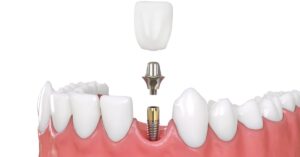
A dental implant is not a single piece, it is a three-part restoration, and each part is made from different materials with specific roles.
The implant post is the part placed surgically into the jawbone. It serves as an artificial tooth root and must be strong enough to withstand daily bite forces while also being well-tolerated by the body. Dental implants in Tumwater use this same foundation to provide a stable base for replacing missing teeth.
The abutment is a small connector piece that sits above the gumline once the implant has healed. It links the post to the final visible crown.
The crown is the custom-made tooth that sits on top of the abutment. It is typically fabricated to match the general color and shape of the surrounding teeth.
Understanding each component separately helps explain why different materials are used in different parts of the same restoration.
Why Is Titanium the Most Common Material for the Implant Post?
Titanium is the most widely used material for dental implant posts because of its biocompatibility and its ability to integrate with living bone tissue, a process called osseointegration.
Osseointegration is what may make an implant stable over time. When a titanium post is placed into the jawbone, the surrounding bone can gradually grow around and attach to its surface. A dentist in Tumwater, WA can evaluate healing and monitor the implant’s stability during this process. This process typically takes several months and is considered a key factor in implant stability. Individual healing outcomes vary based on bone quality, overall health, and other clinical factors.
Titanium has several properties that make it well-suited for implant use:
- It is biocompatible, meaning most patients tolerate it without an adverse immune response, though individual responses can vary
- It is highly resistant to corrosion in the oral environment
- It is engineered to withstand the mechanical forces of biting and chewing
- Its surface can be treated, often with a slightly rough texture, to support bone attachment during healing
As of 2026, titanium remains the most widely used and extensively researched material for implant posts, with a substantial body of peer-reviewed clinical data supporting its use in appropriate candidates.
What Is a Zirconia Implant, and Who Might It Be Considered For?
Zirconia is a ceramic material that serves as an alternative to titanium for patients who prefer or require a metal-free option. Whether zirconia is appropriate for a specific patient depends on a clinical evaluation by a qualified dental professional.
Zirconia dental implants are white in color, which is one reason some patients and clinicians consider them for cases where thinner gum tissue may allow the grayish tone of a titanium post to show near the gumline. Some patients also inquire about zirconia due to concerns about metal in the body. It is worth noting that titanium is classified as biocompatible and is not a common allergen, however, individual responses to any material can vary, and a full medical and allergy history should always be discussed with your dental team before treatment begins.
Key differences between titanium and zirconia implants that your dentist may discuss with you include:
- Appearance: Zirconia is naturally tooth-colored; titanium has a grayish tone
- Research base: Titanium has a much longer clinical track record; zirconia research is more recent and ongoing
- Design: Zirconia implants are often one-piece, while titanium implants are typically two-piece (post plus separate abutment)
- Availability and cost: Zirconia implants may be less widely available and can involve different cost considerations
Whether zirconia may be a suitable option for your specific situation is a determination your dental team will make based on a clinical evaluation of your bone density, gum structure, and overall oral health.
What Are Dental Implant Crowns Made Of?
The crown, the visible part of the implant, is most commonly made from porcelain, zirconia ceramic, or a combination of porcelain fused to a metal base. The appropriate material depends on the location of the implant, the patient’s bite, and clinical judgment.
Full porcelain or full zirconia crowns are used in many cases because of their tooth-like appearance and translucency. They are a common option for implants in areas of the smile where aesthetics are a priority.
Porcelain-fused-to-metal (PFM) crowns combine a metal interior for structural support with a porcelain exterior. They have been used in dentistry for many decades. Over time, as gum tissue changes, the metal base may become visible near the gumline in some patients, this is a factor your dentist may discuss when selecting a crown material.
All-metal crowns (such as gold alloy) are occasionally used in posterior (back) teeth where bite forces are higher and visibility is less of a concern. They are generally not used for implants in visible smile areas.
Your dental team will recommend a crown material based on clinical factors including the implant location, your bite, and your individual needs and preferences.
Does Implant Material Affect How Long the Implant Lasts?
Material selection is one factor that may affect how long an implant restoration holds up, though long-term outcomes depend on multiple clinical and patient-related variables working together.
A titanium post that achieves successful osseointegration may serve as a long-term restoration. Research indicates that many patients maintain functioning implants for a decade or longer, though individual outcomes vary based on bone quality, gum health, systemic health conditions, and daily habits such as smoking or teeth grinding. No specific lifespan can be guaranteed for any individual patient.
Crown materials wear differently over time. Porcelain and zirconia can chip under heavy or repeated force. All-metal crowns are resistant to chipping but are typically not used in visible areas. Your dentist will discuss realistic expectations based on your specific clinical situation and the material selected for your restoration.
Consistent daily care, brushing twice daily, flossing around the implant, and attending scheduled dental visits, is considered one of the most important patient-controlled factors in supporting implant health over time.
Frequently Asked Questions
Are dental implants safe for people with metal sensitivities?
Titanium is biocompatible and not classified as a common allergen, but sensitivities to titanium, while rare, have been documented. If you have a known history of metal allergies or sensitivities, it is important to disclose this to your dental team before any treatment is planned. Dental implants may involve titanium or alternative materials such as zirconia, depending on your specific clinical needs. Your dentist can review your medical history and may discuss whether alternative materials such as zirconia warrant evaluation in your specific case.
What is osseointegration, and why does it matter?
Osseointegration is the process by which bone tissue attaches to the surface of a titanium implant post. When it occurs successfully, it contributes to the stability needed to support a crown and withstand daily bite forces. Healing typically takes several months, and your dental team monitors this process before placing the final crown. Successful osseointegration depends on factors including bone quality, oral hygiene, and overall health.
Is the implant crown made of the same material as the post?
No, the crown and the post are separate components made from different materials. The post is typically titanium, or zirconia in metal-free cases. The crown is most commonly made from porcelain, zirconia ceramic, or a porcelain-fused-to-metal combination. Each material is selected based on its specific function and the patient’s clinical needs.
Can the material of a dental implant cause the implant to fail?
Implant failure related to material intolerance is uncommon, but implant failure can occur for a range of reasons, including infection, inadequate bone density, uncontrolled systemic health conditions, or habits that interfere with healing. This is why a thorough clinical evaluation of your bone structure, gum health, and overall health is an important part of the treatment planning process.
Does it matter which grade of titanium is used in a dental implant?
Dental implant components in the United States are subject to FDA clearance requirements. Dental-grade titanium, typically Grade 4 commercially pure titanium or Grade 5 titanium alloy, is used in cleared implant systems. These materials are required to meet established manufacturing and biocompatibility standards. Your dental team can answer questions about the specific implant system used in your treatment.
Conclusion
Understanding what dental implants are made of is more than a technical detail, it helps you approach a consultation with informed questions and realistic expectations. Titanium remains the most widely used and extensively researched material for implant posts. Zirconia is an option that some patients and clinicians consider for specific situations, and crown materials are selected based on clinical factors including location, function, and individual needs.
At Affordable Family Dental in Tumwater, WA, the team conducts a thorough evaluation of your bone health, gum condition, and overall oral health before making any treatment recommendations. If you would like to learn more about dental implant materials or explore whether implants may be appropriate for your situation, the team is available to walk you through the details at a pace that works for you.
Sources:
- Hoornaert, A. et al. (2020). Biocompatibility and osseointegration of nanostructured titanium dental implants in minipigs. Clinical Oral Implants Research. https://pubmed.ncbi.nlm.nih.gov/32058629/
- Fernandes, P.R.E. et al. (2022). Clinical Performance Comparing Titanium and Titanium–Zirconium or Zirconia Dental Implants: A Systematic Review of Randomized Controlled Trials. Dentistry Journal. https://www.ncbi.nlm.nih.gov/pmc/articles/PMC9140125/
- American Dental Association — MouthHealthy: Implants
Covers titanium/biocompatible materials, osseointegration, and the crown component — directly supports most of the post’s core claims.
https://www.mouthhealthy.org/all-topics-a-z/implants - Busenlechner, D. et al. (2014). Long-term implant success at the Academy for Oral Implantology: 8-year follow-up and risk factor analysis. Journal of Periodontal & Implant Science. https://pmc.ncbi.nlm.nih.gov/articles/PMC4050226/